Josie’s interaction meeting
Klara and the SunJosie’s interaction meeting is the gathering at Josie’s house where the social rules of the lifted children become visible in action. Josie wants Rick there despite his unlifted status, but the meeting leaves him isolated and exposes how readily the other children turn difference into a test of belonging. For Klara, the event is also an education: she observes Josie adopting a social manner unlike the one she uses in private, then learns not to mistake that momentary display for the whole of her character.
Background and Invitation
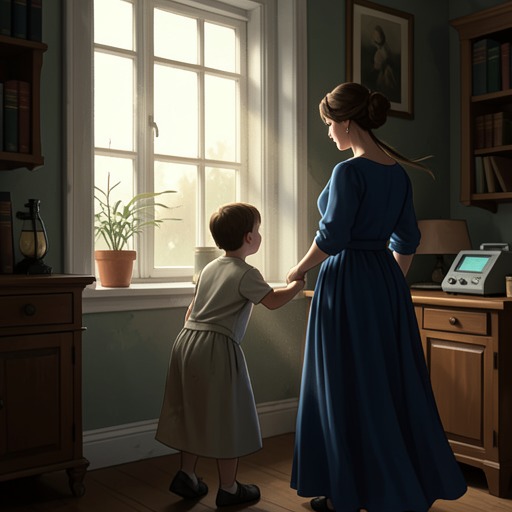
At supper, with the lights dimmed except for those falling on the Island, Josie asks The Mother whether good grades can exempt her from hosting an interaction meeting. The Mother says that cleverness is not enough; Josie must also learn to get along with others. The meeting is therefore not simply a party but an expected exercise in social competence, one that Josie approaches with reluctance.
The Mother suggests that Josie can introduce Klara to her guests, but Josie answers that they are not her friends. She wants Rick to attend. The Mother agrees, while noting that the choice is ultimately Rick’s. Later, as she lies in bed, Josie confides to Klara that she hopes he will come to the “awful party.” Her insistence places Rick at the center of her hopes for the gathering even before he arrives, and makes the meeting a test of whether their connection can hold in the company of other children.
On the morning itself, Josie is anxious enough to return to her bedroom after breakfast and try on different clothes. Even as the guests arrive and Melania Housekeeper calls upstairs for her, Josie keeps brushing her hair. Klara finally tells her it is time to join the guests; Josie drops the brush and says she must face the music. Coming downstairs, they find adult guests filling the hall while the children remain out of sight behind the closed sliding doors to the Open Plan. The separation between adults and children gives the gathering a staged quality: Josie must cross from the familiar household into a social scene whose rules she cannot control.
Rick’s Arrival and Isolation
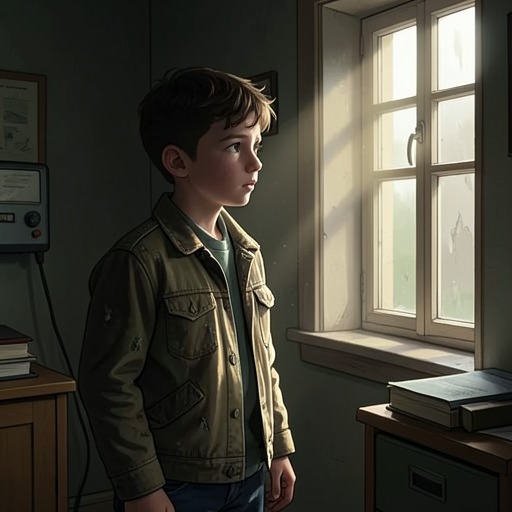
Instead of going straight to the Open Plan, Josie passes through the adults and out to the open front door. With one foot on the threshold, she calls into the outdoors for Rick, urging him to hurry because everyone is already there. She takes his arm and brings him into the hall. He wears the jeans and sweater he wore on the grass mound, but the adults notice him immediately; their conversation continues at a lower volume. His entrance makes the difference in his status legible before the children even begin to speak with him.
Inside the Open Plan, the room has been rearranged into twenty-four boxes in two tiers, dividing the space and fragmenting Klara’s view. Josie is talking with three girls, their faces split by the boxes so that eyes and mouths appear in separate compartments. At the back, three boys sit on a sofa, their heads grouped together in one box and one boy’s leg extending across others. The strange partitions frame the meeting as a scene of people being sorted into visible groupings. Yet the immediate social focus is Rick: although someone calls Klara a cute new AF, nearly all the voices Klara hears concern him.
The girls describe Rick as Josie’s nearby friend and say they should be nice because it must feel strange for him to be among them. One long-armed girl approaches him with a dish of chocolates and offers a bonbon. Rick has been watching Josie, but she has turned away to speak with the girls. When the conversation shifts to what he watches, the questions become a public examination. Josie steps in front of him, angry, and urges him to tell the others what he likes. Rick’s exposure is not eased by the attention: the gathering makes him conspicuous as an outsider while treating his ordinary preferences as something to inspect.
Josie’s conduct is divided between welcoming Rick and performing for the group. She takes a chocolate from him after the guests giggle at the long-armed girl’s effort to defend him, then redirects their attention by introducing Klara to everyone. The shift protects Rick from being the center of attention, but it also leaves him alone again. When Josie tells Klara to go greet the boys on the sofa, her voice sounds to Klara like the one she uses with Melania Housekeeper, not the familiar voice she has used with Klara before. Danny, the tallest boy in the room, questions whether Klara takes commands and then grabs her by both elbows as she approaches the sofa.
Confrontation and Departure
The encounter with Danny turns the meeting’s social unease into a threat of physical coercion. When Danny orders another boy to take Klara’s arms while he takes her legs, Rick interrupts the room by asking what Danny has in his pocket. The object is a small soft toy dog. Rick points it out without showing fear, and then teases Danny for keeping a cute little thing in his breast pocket. Danny’s tenderness toward the toy, hidden under his bullying, briefly reverses the direction of scrutiny: now Rick has identified a vulnerability in the boy who was trying to control Klara.
An adult woman intervenes, tells Rick to leave Danny alone, and agrees that Rick should not be there. The incident thus does not settle into a simple victory for Rick; adult authority reinforces his exclusion even as he has challenged the children’s treatment of Klara. The long-armed girl proposes that everyone go outside, and the children leave with Josie, Danny, and Scrub. Rick and Klara remain behind in the disordered Open Plan, among discarded jackets, cushions, plates, cans, snack bags, and magazines. The empty room makes the gathering’s aftermath visible as a physical mess, while the two left behind are also socially apart from the group.
Rick says he knows he does not belong because the meeting is for lifted children. He had accepted Josie’s insistence that he come, but she has not returned to see how he is managing. Beneath his complaint lies a more personal disappointment: he hoped that if he attended, Josie might not change and might remain the same Josie he remembers. As the Sun’s pattern falls across his face, he says he needs to save her from the others. His response joins the immediate slight to a broader fear that the group will alter the person he loves.
Klara does not accept Rick’s conclusion that the other children are simply unkind. She recognizes that he is afraid Josie will become like them, yet believes Josie remains kind underneath her strange behavior. The children, she thinks, act roughly because they fear loneliness; she allows that Josie may share that fear. This reading does not erase Rick’s hurt, but it shifts the scene from a contest between a good outsider and a cruel group toward a more complicated picture of children managing their own insecurity through social performance.
Aftermath and Meaning
The meeting yields observations that Klara continues to weigh after the guests have gone. Josie’s joking remark that she may have chosen the wrong AF prompts Klara to consider whether Josie might prefer a B3, whose capabilities exceed her own. She also worries that her silence when the long-armed girl questioned her may later anger Josie. Neither fear comes to pass: Josie remains as cheerful and kind to Klara as before and never raises the meeting’s events. The feared rupture between them does not follow from the awkwardness of the gathering.
Klara’s lasting lesson is that people prepare a side of themselves to show to others, much as they might present themselves in a store window. Josie’s different voice, her attention to the guests, and her failure to return to Rick are real parts of the event, but Klara learns not to treat them as conclusive evidence of a permanent change. The meeting therefore distinguishes a public performance from an enduring relationship without pretending that the performance is harmless: Rick feels abandoned, and Klara sees how loneliness shapes the children’s behavior.
The gathering also forms a contrast with the shared future Rick and Josie once imagined. Rick later explains that he thought attending might keep Josie from changing, and says she has lately been speaking again about their plan. Much later, Klara observes that Rick and Josie still show kindness to one another even as they prepare different futures. The interaction meeting does not itself end their bond, but it makes its vulnerability visible: friendship persists through changes in social behavior, while the paths ahead can still diverge.